Content

Showing posts with label people. Show all posts

Location: Agra, Uttar Pradesh, India(27� 10' 48? N, 78� 1' 12? E)
Date: 7 Jan 2009; 3.10pm
Camera: Canon 400D with Sigma 17-70/f2.8-4.5

India is one of a few countries where there is a healthy mix of the old and new. One example is the continue use of colonial era articles. Another very interesting sight is the continue practice of trade in the old fashion way alongside the modern version, be it laundry and ironing services or hair-cut. These days there are swanky air-conditioned saloons in cities such as Mumbai, Delhi and so on; but roadside barbers are doing popular.

Read more »

Location: Sister Meal Festival at Shidong, Guizhou, China (26�40'11.24"N,108�18'14.10"E)
Date: 24 April 2005; 4.50pm

Camera: Canon 300D with kit kens
Lately China had been struggling with their treatment of minorities with a few headline-grabbing incidents. In the last 3 years, there were riots in Tibetan Lhasa, ethnic conflicts in Uighur Urumqi and last month in Inner Mongolia. The problem is the way the Han Chinese perception of their own rule and reading and treating symptoms instead of causes. They are in a classic situation of being blind to their own defects. The resentment of Chinese Han Communist rule by the ethnic minorities in these provinces are so strong that a traveller has to be blind (or travel in a package tour) not to notice or hear about it in these places. But to be fair, not all ethnic minorities in China are hostile towards the Han Chinese majority. Minorities such as the Miaos and Zhuangs enjoy better quality of life now than they ever did in the past in China. They managed to maintain a lot of their culture and celebrate their festivals such as the Miao�s Sister Meal Festival, in ever grander fashion each year; so much so that these festivals are now major tourist attractions.

Read more »

Location : Bac Ha Sunday Market, Vietnam (22� 33' 0 N 104� 16' 0 E)
Date : 5 June 2005; 9.20am
Camera : Canon 300D with Sigma 70-200/f2.8

I always try to visit the local markets wherever I travelled to. One reason for doing so is to satisfy my stomach as quite often the market is where one finds most of the unique local snacks and food at very cheap prices. It is also a good place to see and understand what the local people eats, what�s special fresh produce for the region and so on. However one of the major reasons I visit such markets especially the all-important weekly (or whatever regularity) market/bazaar is to mingle and see the ethnic people in their traditional costumes. In most of the remoter places, there are no regular morning market but only once on a certain day of the week or month. During this day, people who lives in the nearby villages will congregate here to buy, sell, eat, gossip and meet up with friends. And ethnic people in remote places also normally still wears their traditional costume every day. So whether the Yi�s of Yunnan, Uighurs of Xinjiang or Kashmiris Muslims, Market Day is an important date in their weekly or monthly routine.

Read more »

Location: Leh, Ladakh, India (34� 10' 3? N, 77� 35' 24? E)
Date: 18 August 2009 6.20pm
Camera: Canon 300D with EF 70-200/f4 IS L

Ladakh is nothing like the rest of India. It is cold, mountainous and not as crowded as most parts of India, which tends to be steamy and sweaty with humanity. The rest of India is mainly dusty and flat where the representation of Hinduism is everywhere. Some parts of Ladakh are even more dustier and very dry- high altitude desert- but the predominate religious manifestation is that of Buddhism. The major exceptions are Kargil where the majority is Muslim and perhaps Leh, where there is also a significant proportion of Muslims.

The people of Ladakh are also quite different from �mainland� India. Again apart from the Kargil region and Leh, the predominant population are rather Tibetan-looking. In fact without thinking too much, one could have thought that one is visiting Tibet or the Sherpa region of Nepal. The language too is like a Tibetan dialect. Such is the wonder and beauty of Ladakh.

Traveling is a way of living. It allows you to expand your eyes, mind and improve your listening skills, as you encounter a variety of people on your journeys. Reader's Digest supports travel bugs and wanders from all walks of life and believe that a good traveler knows every penny spent is a penny fewer from the next town. Traveling is a way of life and a travel budget is how you survive. We wish the best for Peter throughout all his adventures.

Technorati Tags: ,,
Read more »

Location: Jaisalmer, Rajasthan, India (26� 55' 12? N, 70� 54' 0? E)
Date: 27 Dec 2008; 8.30am
Camera: Canon 400D with Sigma 17-70/f2.8-4.5

The Gypsies or Roma that we know today originated from India and migrated across to the West over a thousand years ago. The origin of their culture is the hostile habitat of the Thar Desert of Rajasthan. Two of the most common group of so-called gypsies in India are the Bopa and Kalbeliya. They are the lowest caste in the Hindu caste system and live a nomadic life, sleeping underneath the stars on the outskirts of towns in Rajasthan. They worked as street performers travelling between fairs and festivals such as those of Pushkar and Bikhaner, as well as selling ethnic jewellery and accessories at tourist spots. They are talented musicians and dancers and they used to be sought after by maharajas as court performers; however their stable livelihood disappeared together with the royalties of India. They can be easily identified by their darker skin, colourful costumes and abundant adornment of accessories, the most common being the nose rings.

Read more »

Location: Mae Hong Son, Thailand (19� 18' 14? N, 97� 58' 38? E)
Date: 13 August 1995; 2.10pm
Camera: (analogue) Olympus Mu on negatives and scanned

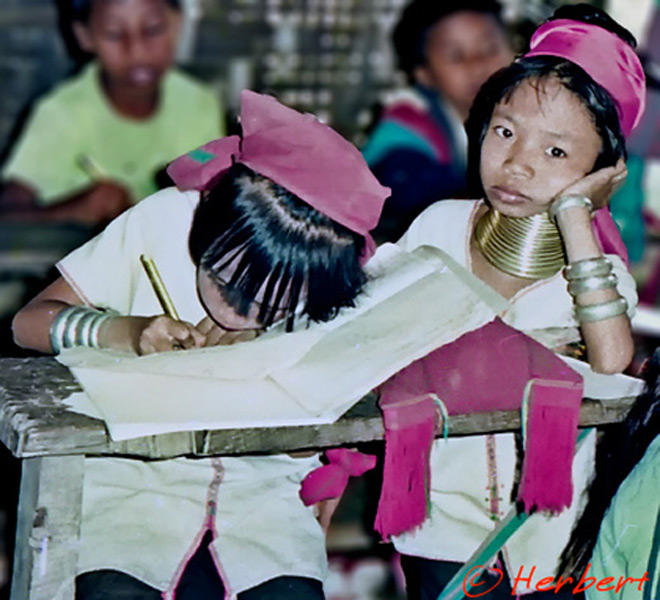
There is a sub-tribe of the Karen tribe living in the Kayah state in eastern Myanmar known as Padaung. They are more well-known as the �Long Neck� tribe as the women supposedly spot �long necks� (or giraffe women). They don�t actually have long necks � they wear rows of brass rings around their necks since young; these rings squash the vertebrae and collar bones as they grow older rather than stretching their necks. They also wear rings around their arms and legs. The reason that they do so is to look like a dragon- their ancestor. Legend has it that the Padaung people are the product of the impregnation by the wind of a beautiful long neck dragon. In Thailand, there are only a handful of Padaungs who are refugees fleeing the persecution by the Myanmese in the 1970�s. There live in the north, bordering Myanmar in villages which are dubbed �human zoo�. Such villages are set up as �tourist attractions� managed by Thais who also provide them protection. Tourists are brought to the village, paying an entrance fee, to see and photograph these ladies. There are allegations that the Padaungs are in fact imprisoned by the Thais that manage the villages and young girls are forced to adopt the ring tradition. While these may be so, the set up does provide the refugees a measure of certainty and protection from eviction (I am sure the �managers� are influential people) which they may not enjoy otherwise. Furthermore they do make a living from the visitors as well as selling whatever handicraft they made. I, personally cannot make a judgment if this is bad or otherwise.

Technorati Tags: ,,
Read more »

Location: Tingri Shekar, Tibet, China, (28� 34' 0? N, 86� 38' 0? E)
Date: 3 May 2003; 10.25am
Camera: Canon G1

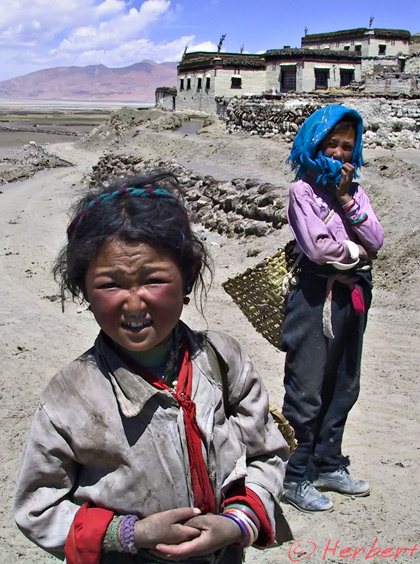
Tingri Shekar is the main though small town on the Tingri Plains, situated approximately 60 km north-west of Mount Everest and just over 50 km from the Nepali border. The Plain is approximately 4,300 meters high and the air is always crisp. Sunrise is really pretty with the thin air bringing out the glows of the dawning sun. This town is frequented by climbers and expeditions to Cho Oyu, which looms across the horizon. It is a place of raw beauty. It is also one of the driest parts of Tibet, being behind the mighty Himalayas- the monsoon clouds dumped their rain when they cool ascending the height of the Himalayas. It is also very poor with little trade crossing this way. Things have changed a little in the last few years with more tourists coming this way to the Everest Base Camp or overland to Nepal. A few of the old houses in town had been rebuilt- a sure sign that things are a-changing. It may stay this way for a couple more years as there are no public transport connecting this place to other parts of Tibet yet. But don�t hold your breath- this is China after all. So if you still want to see a beautiful landscape relatively untouched by developments and still un-swamped by tourists in China, this is it.

Read more »

Location: Kashgar Sunday Bazaar, Xinjiang, China (39� 45' 26 N 78� 24' 18 E)
Date: 3 October 2008; 11.30am
Camera: Canon 400D with Sigma 17-70/f2.8-4.5

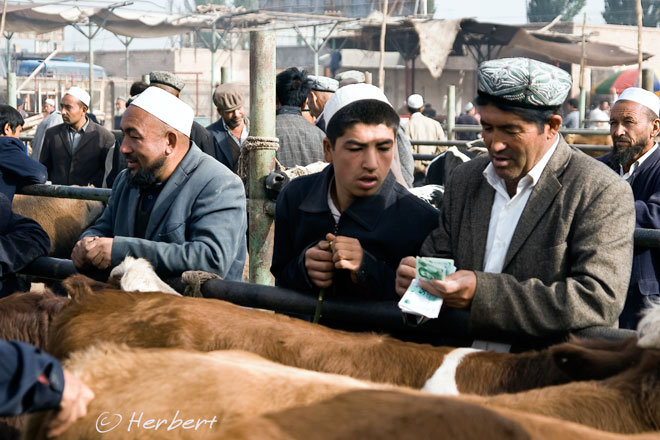
A couple of days ago, Xinjiang had its first anniversary of the deadly racial riots that rocked the province and China. An unfortunate and unavoidable consequence of the riots, in a country such as China, is a heavy clampdown on freedom and restrictions on movements of both foreigners and the ethnic population (Uighurs). By some accounts, internet access to many websites is heavily censored in the province- this is on top of the so-called �Great Firewall� restrictions on internet access generally in China. Activities and movements of the population are monitored around-the-clock by the installation of 40,000 CCTV cameras around Urumqi- reminiscent of the measures already in place around another troubled city, Lhasa. The Chinese government is pouring ever more money into the province for modernization in the hope that this will bring the whole province and population�s economic well-being to a notch closer to the rest of the country. To me, all these action are really missing the point. Xinjiang is already a wealthy province by all measures- it has the majority of China�s oil and gas as well as the land of �white gold� i.e. cotton. The problem is that all these wealth does not filter down to the masses and worst still, it is the Han Chinese who are enjoying the fruits. It is the same situation as in Tibet, with the ethnic people facing decimation vis-a-vis the migrant Hans. Top be fair, a lot of such difficulties faced by the Uighurs is not purposely perpetrated eg. it is not unnatural behaviour for Hans to employ someone from their own province instead of a Uighur. Furthermore some of the disadvantages faced by Uighurs is self-inflict eg. many of the Uighurs refused to learn Chinese and so could not get government jobs or employment by Han enterprises. That said, it is the prerogative of the Chinese government to address these very real issues head-on; sadly, they conveniently overlooked them and march on blindly with their prescriptions, hoping that money will resolve everything. This is just one dimension- there is also the complain that Uighur culture is being swamped by Chinese (the same complaint as in Tibet). The twin consequence of so-called accelerated economic development and the accompanied Chinese migration will definitely see the accelerated demise of century-old traditions in the province. Already Kashgar�s Old Quarters had all but gone; the Sunday Bazaar is just a shadow of its glorious past and may not survive much longer.

Read more »

Location: Camel racing, Bikaner, Rajasthan, India (28� 1' 0? N, 73� 18' 43? E)
Date: 11 Jan 2009; 5.10pm
Camera: Canon 400D with Sigma 17-70/f2.8-4.5

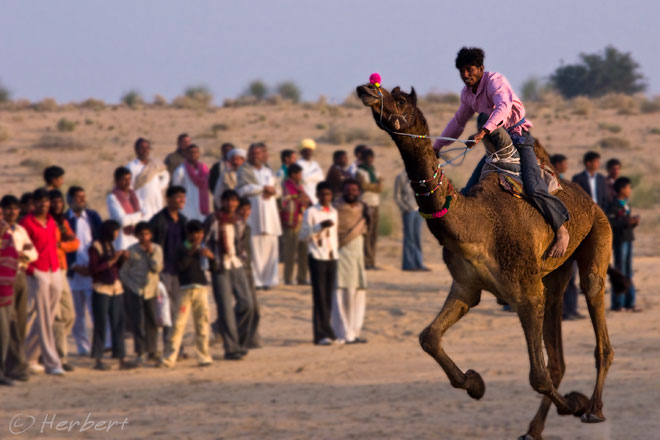
Bikaner is a small town in the amazing state of Rajasthan, with part of the Thar Desert within its boundary. Its claim to fame is its proximity to the incredible �Rat Temple� of Kami Mata at the nearby town of Deshnok. However its council had been trying to make a name for itself in the tourism map of Rajasthan and with some success. It have organised an annual �Camel Festival�, somewhat mimicking that of Pushkar. Unlike that of Pushkar, which is spontaneous and have religious significance, the festival of Bikaner is pure and simple, a top-down festival being run to attract tourists. Nonetheless it is a fun festival, normally running over 2 days with various events including a marvelous Camel Race. Man, those camels can really run- I have never seen or imagine camels can run that fast. It can be pandemonium at the race as the riders are not always capable of keeping the camels within the course; occasionally the camels ran outside the course and right into the crowds- which can cause fatal injuries.

Read more »

Location: Varanasi, Uttar Pradesh, India (25� 16' 55.2? N, 82� 57' 22.68? E)
Date: 29 September 2005; 7.55am
Camera: Canon 300D with kit lens
Varanasi is one of those magical places on Earth that one feels the influence of religions on mankind. Apart from its
array of fabulous architecture, the city is always full of devoted Hindu pilgrims, who perform amazing rites such as bathing and drinking the water of Ganges River. One has to have the utmost of faith and belief to do so as the river is polluted with all sorts of stuff. To me, acts like this (and those of devoted Tibetans prostrating on all fours at sacred temples and prostrating/walking to holy places) are just some of the mysteries and sacrifices that religious faiths can extract from devoted practitioners. Though I have no religious beliefs, such devotion always inspires my unreserved respect.

Read more »

Location: Near Bayi town, Tibet, Tibet, China (29.66639�N 94.36278�E)
Date: 15 August 2007, 8.20am
Camera: Canon 400D with Sigma 17-70/f2.8-4.5

Most Tibetans are rather religious- to them living life is synonymous to living a Tibetan Buddhist life. One of the main objectives of most devoted Tibetans is a pilgrimage to sacred sites such as Potala Palace in Lhasa, Mount Kailash, Yamdroktse and so on. Their sort of pilgrimage is not just hoping on a car or bus to the destinations but to walk and prostrate all the way to the destinations. What this entail is to pray and then prostrate on all fours, laying on the ground facing the direction of the path/road for every three steps. Normally such a journey will be undertaken in a group of 2 or 3 persons. 2 pilgrims will be prostrating all the way to the destinations while a helper will pull a trolley/cart of their belongings, food, tent and camping items alongside. Such a pilgrimage journey could take many days and even months to complete, depending on where the pilgrims live in relation to their destinations. I met this young pilgrim (of a family of pilgrims) on the road near the town of Bayi. They have walked and prostrated from northern Sichuan for about 12 days, on their way to Lhasa. One can see the dark patch on his forehead, which is the result of prostrating and knocking his forehead on the ground. However, look at his expression and one will realise the inner strength and happiness he felt to be embarking on such a pilgrimage.

Read more »

Location: Baoshan, Yuanyang, Yunnan, China (23� 9' 15 N 102� 44' 52 E)
Date: 25 February 2007, 4.20pm

Camera: Canon 400D with Sigma 17-70/f2.8-4.5

Lunar New Year is not only celebrated by Chinese or more accurately, Hans. It is a festival that is also celebrated by many races and nationalities that are influenced by the Chinese culture- Vietnamese, Koreans, to mention a few- also celebrate Lunar New Year (LNY) in a big way. So it is not surprising that many of the ethnic minorities in China also celebrate a variant of the same.

The Yi is a minority residing predominantly in the south and southwest of China including Yunnan, Guizhou, Guangxi etc. They have different custom and a different tradition for LNY celebration. One of them is the Dragon Feast celebration which falls on the 8th day of the LNY. It is a boisterous event where residents of villages will have great fun doing all sort of things, including games, dancing, singing and of course voluminous of rice wine and feasting.

Read more »

Locations: Barkhor Square, Lhasa, Tibet, China (29� 39' 11? N, 91� 7' 53? E)
Date: 11 August 2007; 8.0pm
Camera: EOS 300D with kit lens

One of the characteristics of Tibetan Buddhism is their utmost devotion to things or beings considered holy. This could be either Buddha statues, pictures of the Dalai Lama, monasteries, lakes, mountains and so on. Part of the expressions of faithful devotion is the circumambulation around such items. Devotees or pilgrims would walk a step and then bow with all fours on the floor. If it is a mountain or lake, this would be a kora- circumambulating around the object, normally over a few days depending on the size of the mountain/lake. If it is a monastery or palace such as Potala Palace, it would be several circumambulations. If it is a statue or picture, then they would pray with all fours in front it. This is one of the most commonly seen acts in front of the Jokhang Monastery in Bakhor Square, Lhasa.

Read more »

Location: Chhatrapati Shivaji Terminus, Mumbai, India (18� 56' 24? N, 72� 50' 7.08? E)
Date: 11 April 2007; 2.30pm
Camera: Canon 400D with Sigma 17-70/f2.8-4.5

Happy New Year to everyone. I have been taking a nap, Missing-in-action, so to speak for most of December. I have been rather busy with a few other things, so have to allocate my priorities. Anyway, it is just a nap- like the man here, taking an afternoon nap. I am back- watch this space!!

Read more »

Locations: Barkhor Square, Lhasa, Tibet, China (29� 39' 11? N, 91� 7' 53? E)
Date: 19 May 2005; 6.35pm
Camera: EOS 300D with kit lens

Lhasa is a major pilgrimage destination for devout Tibetan Buddhists. Two of the sites stand out as some of the holiest in their religion- the Potala Palace and Monastery. There are virtually thousands of pilgrims and tourists from all over China visiting these places every day, for various reasons. The Tibetans will come to pray, pay respect and circumambulate at these places while tourists come to see, take photos, be amaze and so on. Barkhor Square where the Jokhang Monastery is located is one of the busiest spot in Lhasa at any day. All sorts of people mill around the square and the atmosphere is positively one of joyousness, especially among the pilgrims who have spend many years planning and relatively big amount of money to come here. Even the kids will not always remember this experience.

Read more »

Locations: Xiahe, Gansu, China (35� 11' 50 N, 102� 30' 36 E)
Date: 26 June 2004; 5.40pm
Camera: Canon 300D with kit lens

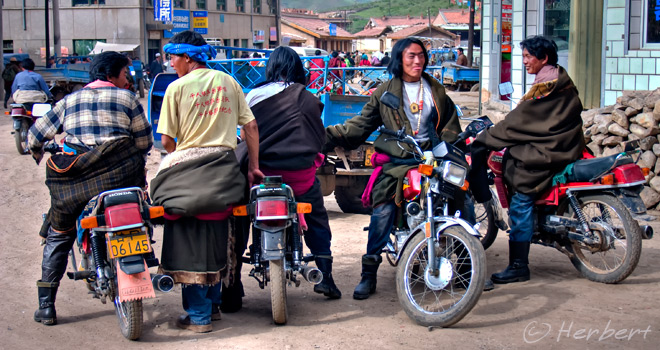
Xiahe is a small town in present-day Gansu. It used to be part of Greater Tibet in the old days and hence, the town is still very predominantly Tibetan in every sense of the word. It is also the location of Labrang Monastery, one of the largest Tibetan Buddhist monasteries outside of the Tibet Autonomous Region. These days, the Tibetans here have substituted their choice of transport from horses while roaming in the mountains and grassland to �steel horses� i.e. the motorbikes. It is common sight to see groups of young Tibetans with their customary cigarette in their mouths on motorbikes gathering to update on the latest developments on the grasslands.

Technorati Tags: ,,
Read more »

Locations: Zhaoxing, Guizhou China (25� 54' 39 N, 109�10' 35 E)
Date: 18 April 2005; 11.45am
Camera: EOS 300D with kit lens

China officially recognised a total of 55 ethnic minority groups apart from the Han Chinese majority. These are distributed all over China, with more diversity in those provinces bordering other countries. For example, Yunnan which share borders with Myanmar, Laos and Vietnam has the largest number of minority tribes, numbering in excess of 50. However, even though Guizhou does not have any national borders, it is home to the second largest diversity of ethnic tribes in China. Unlike Yunnan, the minority tribes in Guizhou are not often found in other countries, e.g. Dong and Buyi. Furthermore most of these ethnic groups live in isolated hillsides and along rivers deep in the hinterland, which are difficult to reach. This ensures that their culture and traditions to remain fairly intact till now. Very often, the minorities still go about their daily lives in their traditional costumes. This may not continue for long as China is developing so fast that these places are not "spared". In fact, tourism has reached these places as one can see from the incredible number of s0-called "minority tours" these days being advertised. Their culture and way of life is likely to change with all such developments and influences. In fact, one of the ugly side effects of tourism development in these places is the corruption of their values by materialism, as I have posted before regarding Chenyang. In any case, Zhaoxing was still a very warm and hospitable village when I visited in early 2005. I wonder how much it has changed since. If you have been there recently, please leave your comments and updates here about the village.

Read more »

Location: Dal Lake, Srinagar, Kashmir, India (34� 5' 24? N, 74� 47' 24? E)
Date: 18 August 2009 6.15am
Camera: Canon 400D with Sigma 17-70/f2.8-4.5

Srinagar is well known for its produce- fruits and vegetables. It is supposedly also well-know for flower cultivation. There is a daily floating market in the morning, selling vegetables mainly. It is on Dal Lake and is just a normal affair for locals but attracts a fair number of curious tourists, like yours truly. Actually, it is not much of a big deal but rather a little novella bit like the floating markets in places like Bangkok but smaller. Nevertheless, I still enjoy watching the local people going about their own way of life, which has not changed for decades. In fact, what I enjoy most was not so much the market but the nuances of the people, such as the friendliness, the bargaining and the most interestingly the lack of females in the market; Srinagar is mainly Sunni but is not dogmatic or fundamental.

To get to the floating market on Dal Lake, one needs to start early- preferably around 5.30am. It takes about 30-45 minutes for the shikara to get to the market from the Dal Gate area. You should budget to spend between 1� to 2 hours for this activity. It is advisable to make your arrangements the day before with the shikara owner on the timing and rendezvous place. Of course, you should have negotiated and agreed on a price. The price varies depending on the duration and the season of the year. I paid 200 INR for 2 hours in August.

Read more »

Location: DuoYi He, Yunan, China (24�45'56.77"N 104�29'50.85"E)
Date: 1 March 2007, 7.30m
Camera: Canon 400D with EF70-200mm f/2.8L USM

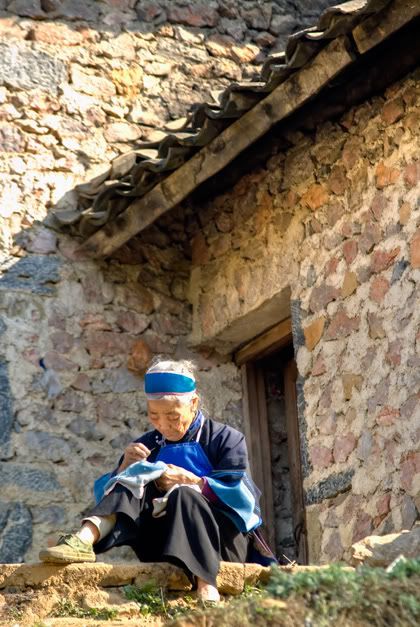
Buyi is a minority tribe in China, living predominantly in the provinces of Yunnan, Guangxi, Guizhou and Sichuan. A big proportion of them lives at the border of Yunnan and Guizhou, an area know as GuiYun with deep canyons in limestone karsts cut by numerous rivers. The Buyi are indistinguishable from the major minority of Guizhou, the Zhuang; studies had established that they share common ancestry. Those who lives in the urban area in fact looks no different from any Hans. However in the villages, most of the women still wear their traditional clothing of "trousers with a long-sleeved blue jacket buttoned on the right or an embroidered coat with a long pleated batik-design skirt. The front sleeves and shoulders of the coat will be decorated with batik cloth or embroidery. Women may wear brightly coloured aprons. Unmarried women may wear a black or striped kerchief with a bow on their heads. Married women will wear a turban. Men wear long pants and short embroidered jackets." (quotes from an excellent article on the Buyi).

Technorati Tags: ,,,
Read more »

Locations: Chengyang, Guangxi, China ( 25� 54' 19" N, 109� 39' 17" E)
Date: 16 April 2005; 4.20pm
Camera: Canon Ixus IZoom

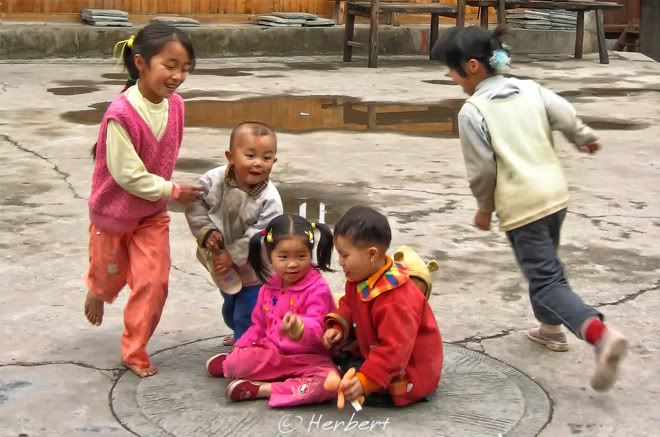
Chengyang is a traditional village of the Dong minority in Guangxi. It is well-known for its Wind and Rain Bridge and Drum Towers. As is traditional in such ancient Dong villages, there are also a couple of places where the community would gather in the village such as open-air opera house. When there are no gatherings or events in these places, they became the playground for the kids. There are hundreds of Wind and Rain Bridges in Guangxi as virtually every Dong village would have one. Chengyang's is one of the finest, most elaborate and well-preserved and was built in 1916. It is a popular tourist destination for visitors in this part of the province. It is so popular that the village is "poisoned" by its popularity. Instead of being the usual hospitable, warm and friendly Dong village (I have been to many and all of them are very, very friendly and warm), most of its residents only see dollar (oops, I mean Yuan) sign in their dealings with outsiders. Money is demanded from any outsiders who want to take a photo of the residents (adults demand it on behalf of kids), their houses or even walk into a public area such as this opera house compound! It was one of my most disgusted experiences in rural China.

Read more »

About

Nothing happens when you sit at home. I always make it a point to carry a camera with me at all times…I just shoot at what interests me at that moment. – Elliott Erwitt"
“I treat the photograph as a work of great complexity in which you can find drama. Add to that a careful composition of landscapes, live photography, the right music and interviews with people, and it becomes a style.” – Ken Burns