
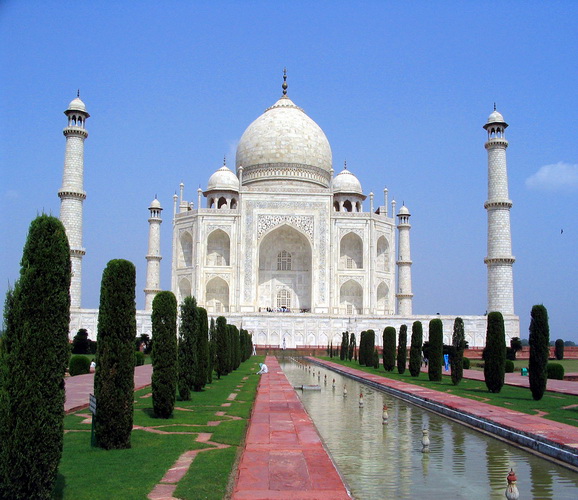
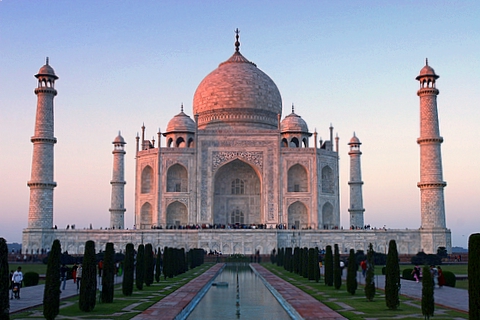


Location: Agra, Uttar Pradesh, India(27� 10' 48? N, 78� 1' 12? E)
Date: 7 Jan 2009; 3.10pm
Camera: Canon 400D with Sigma 17-70/f2.8-4.5
India is one of a few countries where there is a healthy mix of the old and new. One example is the continue use of colonial era articles. Another very interesting sight is the continue practice of trade in the old fashion way alongside the modern version, be it laundry and ironing services or hair-cut. These days there are swanky air-conditioned saloons in cities such as Mumbai, Delhi and so on; but roadside barbers are doing popular.
Location: The Haji Ali Dargah islet, Mumbai, India (18� 59' 6? N, 72� 48' 36? E)
Date: 11 April 2007; 4.40pm
Camera: Canon 400D with Sigma 17-70/f2.8-4.5
The Haji Ali Dargah is a landmark in the southern part of Mumbai. It is both a mosque and a tomb located on an islet off the coast on the Arabian Sea. The Haji Ali Dargah was constructed in 1431 in memory of a rich Muslim merchant, Sayyed Peer Haji Ali Shah Bukhari. Bukhari was from Bukhara, in the ancient Persian Empire and now in Uzbekistan, who gave up all his worldly possessions before making a pilgrimage to Mecca. He travelled around the world in the early to mid 15th century, and then settled in Mumbai.
Haji Ali Dargah is connected to the mainland by a narrow km long causeway that is submerged during tides; it is only accessible during low tides. This does not deter the 80,000 odd pilgrims, irrespective of faith and religion, who visits the tomb every week to get the blessings of the legendary saint. It is quite festive to visit the tomb on Thursdays and Fridays when it is packed with pilgrims and visitors. Occasionally there are also sufi musicians who perform sufi devotional music at the Dargah.
Location: Leh, Ladakh, India (34� 10' 3? N, 77� 35' 24? E)
Date: 18 August 2009 6.20pm
Camera: Canon 300D with EF 70-200/f4 IS L
Ladakh is nothing like the rest of India. It is cold, mountainous and not as crowded as most parts of India, which tends to be steamy and sweaty with humanity. The rest of India is mainly dusty and flat where the representation of Hinduism is everywhere. Some parts of Ladakh are even more dustier and very dry- high altitude desert- but the predominate religious manifestation is that of Buddhism. The major exceptions are Kargil where the majority is Muslim and perhaps Leh, where there is also a significant proportion of Muslims.
The people of Ladakh are also quite different from �mainland� India. Again apart from the Kargil region and Leh, the predominant population are rather Tibetan-looking. In fact without thinking too much, one could have thought that one is visiting Tibet or the Sherpa region of Nepal. The language too is like a Tibetan dialect. Such is the wonder and beauty of Ladakh.
Traveling is a way of living. It allows you to expand your eyes, mind and improve your listening skills, as you encounter a variety of people on your journeys. Reader's Digest supports travel bugs and wanders from all walks of life and believe that a good traveler knows every penny spent is a penny fewer from the next town. Traveling is a way of life and a travel budget is how you survive. We wish the best for Peter throughout all his adventures.

Location: Jaisalmer, Rajasthan, India (26� 55' 12? N, 70� 54' 0? E)
Date: 27 Dec 2008; 8.30am
Camera: Canon 400D with Sigma 17-70/f2.8-4.5
The Gypsies or Roma that we know today originated from India and migrated across to the West over a thousand years ago. The origin of their culture is the hostile habitat of the Thar Desert of Rajasthan. Two of the most common group of so-called gypsies in India are the Bopa and Kalbeliya. They are the lowest caste in the Hindu caste system and live a nomadic life, sleeping underneath the stars on the outskirts of towns in Rajasthan. They worked as street performers travelling between fairs and festivals such as those of Pushkar and Bikhaner, as well as selling ethnic jewellery and accessories at tourist spots. They are talented musicians and dancers and they used to be sought after by maharajas as court performers; however their stable livelihood disappeared together with the royalties of India. They can be easily identified by their darker skin, colourful costumes and abundant adornment of accessories, the most common being the nose rings.
Location: Charminar, Hyderabad, Andhra Pradesh, India (17� 21' 41? N, 78� 28' 28? E)
Date: 27 November 2005; 2.45pm
Camera: Canon 400D with Sigma 17-70/f2.8-4.5
Hyderabad is the 6th largest city in India. It has developed by leaps-and-bounds in the last few years especially as a major hub in the IT industry, earning itself the nickname �Cyberabad�. It is also the home of the Telugu Film Industry, second biggest only to Bollywood in India; that�s why the city is sometimes referred to as Tollywood. It has a huge Muslim minority and one of the most famous monument of the city is the Charminar literally meaning the Four Minarets. Charminar was built by a Sultan in 1591 after fulfillment of a prayer for the end of a plague that was ravaging the city. The monument is in fact a mosque (on the top floor of the structure) within a fort, made of granite, lime, mortar and pulverised marble. Surrounding the monument is the most bustling bazaar of Hyderabad, the Laad Bazaar. Due to the big Muslim population of the city, Hyderabad has reputedly the best Nasi Biryani (a Muslim rice dish) one can ever find in India.
Location: Dal Lake, Srinagar, Kashmir, India (34� 5' 24? N, 74� 47' 24? E)
Date: 15 August 2009 8.30am
Camera: Canon 400D with Sigma 17-70/f2.8-4.5
This was Dal lake of Srinagar a year ago. Just how much things have changed for the Kashmir Valley in just one year. Protests on the streets of Srinagar in the middle of this year descended into killings of activists and protesters by the Indian Army and Police. The death toll was at least 60, mostly rock-hurling civilians shot dead by police. Whilst the Kashmiri issues are complex and intractable, it is still rather hypocritical of the so-called Western democracies for not raising much of a ruckus to India over the killings. The same cannot be said if the country was Iran or China. Civilian lives often became pieces of pawn on a chessboard to be sacrificed for the greater gains. I was blessed to have the opportunity to visit this beautiful place during one of its most peaceful period and I hope that peace and common sense will again prevail in the Valley very soon.
Location: Golden Temple at Amritsar, India (31� 36' 0 N, 74� 52' 0 E)
Date: 24 June 2007: 6.30pm
Camera: Canon 400D with Sigma 17-70mm/f2.8-4.5
The Sikh Golden Temple of Amritsar is definitely one of the highlights of anyone�s visit to India. Though it is not as well-known or popular as some other Indian destinations such as Taj Mahal, Red Fort etc, it is to me, one of the most memorable destinations of India. As was discussed in a previous post on this temple, this place exudes a certain sense of peacefulness and tranquility like no other places in India. If the UNESCO Heritage Site includes existing places of worship, the Golden Temple will definitely get my vote as a candidate.
Location: Hawa Mahal, Jaipur, Rajasthan, India (26� 55' 26? N, 75� 49' 36? E)
Date: 3 Jan 2009; 8.30am
Camera: Canon 400D with Sigma 17-70/f2.8-4.5
Jaipur forms one of the legs of the so-called �Golden Triangle� of Delhi-Agra-Jaipur that nearly every tourist to India will visit. The city is a chaotic city- just like anywhere in India- and has a few interesting attractions, including the UNESCO Heritage Site of Jantar Mantar. However I always enjoy visiting the Hawa Mahal in the city.
Hawa Mahal means the �Palace of Winds� and is part of the City Palace complex. Nothing much of it is left except its exterior five-storey structure. The structure was designed like the crown of the Hindu god, Krishna. but with 953 small windows known as jharokhas, decorated with intricate lattice work. the windows was designed to allow royal ladies to observe everyday life in the street below without being seen as they have a tradition of strict face covering (purdah) for the ladies then. Hawa Mahal was for many years in a rather derelict state with peeling paint and broken windows until a restoration effort that started in 2005. It is now somewhat more �pretty�.
 Location: Bundi, Rajasthan, India (25� 26' 24? N, 75� 38' 24? E)
 I saw this painting of Ganesha outside houses in Bundi. There are different versions but of them are of Ganesha. I did not quite discover the reasons for this but I guess it has to do with the fact that Ganesha is a symbol of prosperity and is believed to be destroyer of all obstacles which come in its way. Hence just like the Chinese Door Gods, Ganesha is supposed to do the same.
Location: Juhu Beach, Mumbai, India (19� 6' 0? N, 72� 49' 48? E)
Date: 17 April 2007 6.15pm
Camera: Canon 400D with Sigma 17-70/f2.8-4.5
Juhu is one of the most affluent suburbs of Mumbai where many of Bollywood�s stars live. It has a sprawling beach, Juhu Beach, which is very popular with Mumbai-ans. It is always jam-pack with people in the evenings and during weekends. The beach is actually pretty nice, facing the Arabian Sea, though the waves can be quite strong. There are many luxury hotels and apartments along the beach, especially at the southern end. There are also some exquisite shops and restaurants which are popular with the increasing number of young professionals, along the Juhu Road. It is probably the only beach in Mumbai that I will swim. It is also a fun place (for me) to watch people.
Location: Camels & riders, Jaisalmer, Rajasthan, India (26.92oN, 70.9oE)
Date: 30 Dec 2008; 3.30pm
Camera: Canon 400D with Sigma 17-70/f2.8-4.5
A good friend of mine who have been to the Namib Desert of Namibia was terribly upset and disappointed with �the so-called dessert and camel rides� in Rajasthan. I thought it was humorous for her to expect the Thar Desert to be anything remotely close to the great sandy dunes of Africa. I supposed if the Tourism people of India and Rajasthan did not make such a big deal out of the �desert experience� of Rajasthan, tourists� expectations will not be so high. Anyway I did not have high expectations when I did the so-called �camel safari� after hearing the feedback from my friend. So I was not disappointed. To me it was just a night out in the so-called desert.
Location: Camel racing, Bikaner, Rajasthan, India (28� 1' 0? N, 73� 18' 43? E)
Date: 11 Jan 2009; 5.10pm
Camera: Canon 400D with Sigma 17-70/f2.8-4.5
Bikaner is a small town in the amazing state of Rajasthan, with part of the Thar Desert within its boundary. Its claim to fame is its proximity to the incredible �Rat Temple� of Kami Mata at the nearby town of Deshnok. However its council had been trying to make a name for itself in the tourism map of Rajasthan and with some success. It have organised an annual �Camel Festival�, somewhat mimicking that of Pushkar. Unlike that of Pushkar, which is spontaneous and have religious significance, the festival of Bikaner is pure and simple, a top-down festival being run to attract tourists. Nonetheless it is a fun festival, normally running over 2 days with various events including a marvelous Camel Race. Man, those camels can really run- I have never seen or imagine camels can run that fast. It can be pandemonium at the race as the riders are not always capable of keeping the camels within the course; occasionally the camels ran outside the course and right into the crowds- which can cause fatal injuries.

Location: Varanasi, Uttar Pradesh, India (25� 16' 55.2? N, 82� 57' 22.68? E)
Date: 29 September 2005; 7.55am
Camera: Canon 300D with kit lens
Varanasi is one of those magical places on Earth that one feels the influence of religions on mankind. Apart from its array of fabulous architecture, the city is always full of devoted Hindu pilgrims, who perform amazing rites such as bathing and drinking the water of Ganges River. One has to have the utmost of faith and belief to do so as the river is polluted with all sorts of stuff. To me, acts like this (and those of devoted Tibetans prostrating on all fours at sacred temples and prostrating/walking to holy places) are just some of the mysteries and sacrifices that religious faiths can extract from devoted practitioners. Though I have no religious beliefs, such devotion always inspires my unreserved respect.
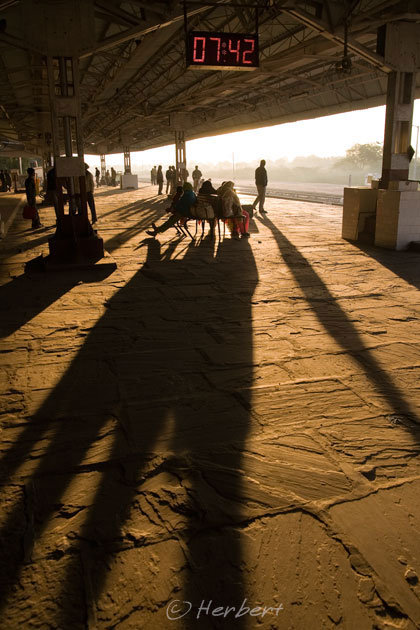

Location: Taj Mahal, Agra, Uttar Pradesh, India (27� 10' 48? N, 78� 1' 12? E)
Date: 29 August 1998; 9.20am
Camera: (analogue) Canon 500N with negatives and scanned
This is the frontal view of that most famous monument of love, Taj Mahal, that most people often sees. This is also the so-called symmetrical view where one sees all the elements of the Taj�s architecture in perfect symmetry. However personally I like the view from across the Yamuna River better. However a little bit of effort is needed to see that.

Location: Namgyal Tsemo Gompa, Leh, Ladakh, India (34� 10' 3? N, 77� 35' 24? E)
Date: 18 August 2009 5.50 pm
Camera: Canon 400D with Sigma 17-70/f2.8-4.5
Leh is one of those places that used to evoke a certain sense of mystique. One of the reasons is its isolation due to its inaccessibility, being only reachable by roads for few months of the year. Even during those months, the road conditions between Leh and Menali can still be quite an adventure. Well, this is no more as there are now many daily flights between Leh and Delhi operated by a few airlines and some of them are reasonably inexpensive if booked in advance. However the best way to get to Leh is still by road as the journey itself is quite an adventure with beautiful sceneries to be had along the way. A word of caution- as the road passes over a few 4,000+ meters passes, the risk of AMS is high. At Leh, one can be awarded with a fabulous panorama of the town set amongst the snow-covered peaks of the Ladakh Range. When in Leh, another must-go destination to enjoy the panorama from a different perspective is from the Shanty Stupak. From here, you will have the view of this photo, looking across towards the town with its enigmatic Leh Palace and the Nagoya Stem Gump pictured here (best visited for sunset).

Location: Lamayuru, Ladakh, India (34� 16' 58? N, 76� 46' 28? E)
Date: 12 August 2009 8.15am
Camera: Canon 400D with Canon EF 70-200 mm F4L IS USM lens
Lamayuru monastery is one of the largest and oldest monasteries in India. It is situated about 3,800m above sea level in the Zanskar range with mountains of dramatic rock composition and structure. Such dramatic landscape is commonly referred to as Moonscape, with rocks varying from sedimentary to volcanic and colours from golden yellow, green, grey and bluish. It is a very dry area as all the monsoon rains are dumped while the clouds climbed the high Himalayan range. It is a land of dramatic and harsh beauty.

Location: Chhatrapati Shivaji Terminus, Mumbai, India (18� 56' 24? N, 72� 50' 7.08? E)
Date: 11 April 2007; 2.30pm
Camera: Canon 400D with Sigma 17-70/f2.8-4.5
Happy New Year to everyone. I have been taking a nap, Missing-in-action, so to speak for most of December. I have been rather busy with a few other things, so have to allocate my priorities. Anyway, it is just a nap- like the man here, taking an afternoon nap. I am back- watch this space!!

Location: Rats feeding on milk, Deshnok, Rajasthan, India (27� 47' 26? N, 73� 20' 27? E)
Date: 10 Jan 2009; 9.30am
Camera: Canon 400D with Sigma 17-70/f2.8-4.5
Kami Mata was a female Hindu sage worshipped as an incarnation of Durga. There were several temples built and dedicated to her. The most famous of all is the temple in Deshnok, a village south of Bikaner in Rajasthan. The temple is famous for its rats, known as kabas and is supposedly reincarnations of a family who have a member revived by Kami Mata. These rats, literally in the thousands, run riot over the temple complex, dashing around to feed on the food- fruits, sweets and so on- and milk left by pilgrims and worshippers. The rats vary in sizes but most of them are rather small. They are harmless and are quite fun to watch. There are holes around the temple courtyard to fascinate the rats' movements. It is considered auspicious to have a kaba running around and/or across your feet.


