Content

Showing posts with label China. Show all posts

Locations: Sera Gompa, Lhasa, Tibet, China (29� 41' 53? N, 91� 8' 0? E)
Date: 18 May 2005; 5.50pm
Camera: Canon 300D with kit lens

Any visitors to Lhasa must visit Sera Monastery, which is within Lhasa limit at the northeast corner of town. One can easily get there by public bus. There are several reasons to visit this monastery including its historical and religious significance and the size and expanse. However one good reason to visit it is to witness the daily Scripture Debate by the resident monks. The monastery had developed over the centuries as a place of scholarly learning with many famed monks in Tibetan Buddhism having trained here. Everyday around 3pm, the resident monks will gather in the garden within the compound of the monastery to debate Buddhist scriptures and philosophy. The debates are punctuated by physical gestures such as hands clapping after each question, loud screaming and verbal exchanges that tremendously enliven the ambience of the debates. Some of such gestures may seem so violent that it may appear to an uninformed observer that the monks may be having a heated argument. These debates make this monastery a special experience.

Read more »

Location: Pingyao, Shanxi, China (37� 12' 5? N, 112� 9' 16? E)
Date: 10 October 2008; 2.50pm
Camera: Canon 400D with Canon 70-200 f/4 L IS Lens

There are still quite a few places in China that maintain their heritage architecture, though this is dwindling by the day. Many places had been demolished to make room for modern developments; the most notorious example of this were the wholesale destructions of the hutongs of Beijing. Many of the remaining ancient architecture throughout China managed to escape the same fate by turning themselves into tourists attractions. They draw tourists, both Chinese and foreigners and their attractiveness as a tourist destination saves them from the hammer of destruction. However these structures faced a different onslaught- commercial developments and exploitations. More and more of the old buildings and houses in places such as Lijiang Old Town had been turned into tourist shops selling all sorts of stuff, instead of being preserved as domestic dwellings, in the process losing its �soul�. I guess this is better than losing them totally.

Pingyao in Shanxi is likely to follow then path of towns such as Lijiang and Fonghuang soon. Pingyao was a financial center during the Qing Dynasty and still retains its city layout from the Ming and Qing dynasty. Within its renowned well-preserved ancient city walls are close to 4,000 preserved Ming and Qing-style residences. The streets and storefronts currently still largely retain their historical appearance. Undoubtedly the winds of tourism exploitation will soon transform this quaint and friendly little town into another must-see on the tourist map, changing the character of the building and its population in the process. This may be the only way to ensure the survival of such ancient towns in China.

Technorati Tags: ,
Read more »

Location: Sister Meal Festival at Shidong, Guizhou, China (26�40'11.24"N,108�18'14.10"E)
Date: 24 April 2005; 4.50pm

Camera: Canon 300D with kit kens
Lately China had been struggling with their treatment of minorities with a few headline-grabbing incidents. In the last 3 years, there were riots in Tibetan Lhasa, ethnic conflicts in Uighur Urumqi and last month in Inner Mongolia. The problem is the way the Han Chinese perception of their own rule and reading and treating symptoms instead of causes. They are in a classic situation of being blind to their own defects. The resentment of Chinese Han Communist rule by the ethnic minorities in these provinces are so strong that a traveller has to be blind (or travel in a package tour) not to notice or hear about it in these places. But to be fair, not all ethnic minorities in China are hostile towards the Han Chinese majority. Minorities such as the Miaos and Zhuangs enjoy better quality of life now than they ever did in the past in China. They managed to maintain a lot of their culture and celebrate their festivals such as the Miao�s Sister Meal Festival, in ever grander fashion each year; so much so that these festivals are now major tourist attractions.

Read more »

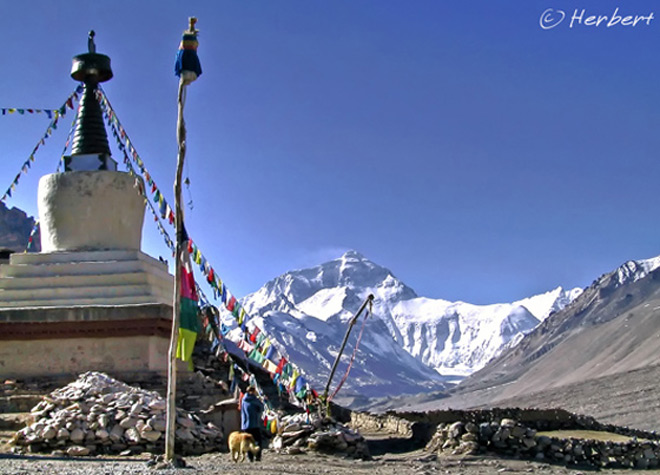
Location: Rhongbuk Monastery (5,100m), Tibet, China (28.194N, 86.829E)
Date : 27 April 2003; 10.25am
Camera : Canon G1

I always wanted to go back to see Mount Everest, either the Nepali or Tibetan (Chinese) side. Going to the Base Camp from the Chinese side has become much more easier in terms of transportation and access, but the problem now is in fact access to Tibet. I just applied for a visa to visit China and to my horror, instead of just one page of form to complete, I have to fill 7 pages now!! And unlike in the past, this must be accompanied by airline bookings (this was introduced just before the Olympics but was never taken off since). Travelling into Tibet is now ever more strict. Chances of getting in without a TTP and getting away is rather difficult as there are now numerous checkpoints and the guards are more vigilant. Perhaps I should try the cycling option next time- I think they are less likely to check cyclists- as long as one dressed more Chinese-like, and of course, have to look Chinese.

Read more »

Location: Old Jinshan, Taiwan (25� 14' 10? N, 121� 37' 3? E)
Date: 3 May 2010, 4.15pm
Camera: Canon 400D with Sigma 17-70/f2.8-4.5

There are a few activities that will excite any visitors to Taiwan. One of them is to enjoy the numerous excellent hot springs dotted around the coast of the country. Taiwan lies on the edge of the Ring of Fire around the Pacific and has some earthquake and volcanic activities resulting in many hot springs. Taiwanese also has a traditional to soak in hot springs, perhaps partly influences from their Japanese colonial past. Many of these hot springs are developed into resorts and at certain times of the year, are crowded by domestic tourists. Old Jinshan (meaning Old �Gold Hill� reference to its previous glory days as a gold mining town) is one of such popular hot spring resorts. It is less than 2 hours north of Taipei and draw lots of visitors from the city during the weekends to enjoy its hot springs, sourced from the hills, as well as its local market and reasonably rustic shoreline.

Read more »

Locations: Rupuchaka Hot Springs, Sichuan, China (28� 46' 0? N, 100� 19' 0? E)
Date: 2 June 2004; 5.30pm
Camera: Canon 300D with kit lens

This Hot Springs is a few km from Daocheng, which is the gateway to the Yading Reserve. Yading Reserve is a major Tibetan pilgrimage site with 3 mountains considered sacred by Tibetan Buddhists. The Reserve has many snow-peak mountains and alpine lakes and is especially pretty in autumn. Like most beauty spots in China which are converted to Reserve, the whole process is messy. After the pasture has been converted to a Reserve, the activities of the people who lives there are heavily curtailed; but compensation was agreed based on a small % of the door intake. However apparently nothing was paid out and there were racial tension (the Reserve operators is a well-connected Han company while the Reserve and surrounding area is predominantly Tibetan) resulting in a couple of deaths. As a result the Reserve was closed to the public for a few years as the security establishment sort things out (which is normally not a pleasant thing in China). It has now been reopened for a couple of years. However with the recent deadly protests across Tibetan areas and the current protests at Kirti Monastery (which resulted in Tibetan deaths), Yading Reserve might be closed to foreigners soon as China customarily applies sledgehammer approach to balcking out of information about domestic problems.

Read more »

Location: Kuqa Grand Mosque, Xinjiang, China (41�43'11"N, 82�55'27"E)
Date: 22 May 1999; 2.30pm
Camera: (analogue) Canon 500N with negatives and scanned

Only 2.5% of China�s population is Muslim, however she has the 9th largest Muslim population in the world. China�s Muslim broadly fall into 2 large groups:

  • the bigger grouping of Muslim population of the Uighurs and other Central Asian ethnic groups concentrated in the western provinces of Xinjiang and Gansu
  • the Hui minority who are descendants of centuries-old inter-marriage between Arab settlers and Chinese, spread all over China.

The former still retain very strong Muslim traditions and practices that are similar to those in Central Asian and other Muslim-majority countries while the Hui minority has incorporated many aspects of Chinese culture. Example of the subtle differences can be found in their mosque architecture- while the former�s mosque are simple and �strong� to withstand the elements, similar to those of Central Asian countries, the Hui�s mosque are sometimes indistinguishable from a Chinese pagoda.

A fine example of the former is the Kuqa Mosque, the second largest mosque in Xinjiang.

Technorati Tags: ,,,
Read more »

Location: Yarlung Valley, Tibet, China (29� 8' 38.76? N, 91� 48' 0.72? E)
Date: 26 May 2005; 10.45am
Camera: Canon 300D with kit kens

The Chinese government had done it again- they closed the province of Tibet to foreigners again! The closure this time is total- not even foreigners on packaged groups are allowed to enter Tibet for a period of three months. I have bemoaned how some places in Tibet are becoming a �once a lifetime� destination due to the now frequent and arbitrary closure to foreigners. The reasons given by the Chinese government this time are ostensibly�bad weather and insufficient supply of accommodation�. Well, the weather in China had not been bad until today and there were reports from the hospitality industry in Tibet expressing puzzlement at the so-called heavy demand on accommodation. In fact the real reasons are the anniversary of the Lhasa unrest three years ago and the timing of the convening of the parliament of the Tibetan government-in-exile in India. The government was trying to avoid leakage of any scenes of demonstrations or unrests of any kind that may result due to these events. While politically I have less of a problem regarding the so-called Tibetan issue, I do have lots of reservations regarding the governance and the iron-fist treatment of minority-dominated provinces such as Tibet and Xinjiang by the Chinese government.

Read more »

Location: Kirti Monastery, Langmusi, Gansu, China (34� 5' 16 N,102� 37' 41 E)
Date: 28 June 2004, 4.10pm
Camera: Canon 300D with kit lens

Langmusi is a small Tibetan town on the border of Sichuan and Gansu. In fact, the northern part of the town is in Gansu while the southern half lies in Sichuan. The town at an altitude of 3,325m is situated in a beautiful valley surrounded by alpine forests and mountains. The town only has a population of around 4,000, with more than 1,000 of them belonging to the two Yellow Hat monasteries found in the village, Sertri Monastery on the north (Gansu) and the larger Kirti Monastery on the south (Sichuan) side of the town. Apart from these two monasteries, there is also a very interesting mosque in the town; the mosque is so �Chinese� looking that one could have mistaken it as a pagoda. This town is also the location of the only Sky Burial Grounds on the whole of China that is open to the public (well, it was still in 2004). The town has a very peaceful feel and is ideal for spending a couple of days hiking around the hills and mountains to discover more pretty remote villages.

Read more »

Location: Ganden Gompa, Tibet, China (29� 45' 28.8? N, 91� 28' 30? )
Date: 18 August 2007, 9.30am
Camera: Canon 400D with Canon 70-200/f4L USM

Ganden Gompa is frequented by travellers to Tibet because of its proximity and easy access from Lhasa. It is situated at 4,300m and has fantastic panoramas of the Lhasa plains and valley. It also has a very interesting history to top off the view. It belongs to the Gelukpa or �Yellow Hat sect� of Tibetan Buddhism of which the Dalai Lama comes from. The monastery is one of 3 Gelukpa monasteries of Tibet. It was the original monastery of the Gelukpa order, being founded by the order�s founder, Je Tsongkhapa himself. His body was preserved and entombed in the monastery until the virtual complete destruction of the monastery by the Red Guards during the Cultural Revolution. Most of his mummified body was burnt except his skull and some ashes which were saved by the monk who was forced to carry the body to the fire. The Gandem Gompa was later re-established by the exile Tibetan population in the Tibetan settlement of Mundgod in Karnataka, India. Meanwhile the original Ganden Gompa in Tibet was reconstructed since 1980�s and more buildings are still being added today, partly due to its popularity on the tourist map. The Ganden Gompa is also one of the few remaining sacred sky burial ground in Tibet.

Technorati Tags: ,,
Read more »

Location: Tashkurgan, Xinjiang, China (37� 46' 18? N, 75� 13' 43? E)
Date: 27 July 2007, 7.50am
Camera: Canon 400D with Canon 70-200/f4L USM

Tashkurgan is a small town on the Karakorum Highway that runs between China and Pakistan. It is at a high altitude of 3,200m and is a recommended overnight stop for travellers from China to Pakistan so as to have a a better chance of crossing the snow-prone Khunjerab Pass (border between China and Pakistan, the highest border of the world,) in daylight. The Pass is closed during winter as the roads will be blocked by snow. Tashkurgan was a vital stop on the old Silk Road as caravans from all directions converged here- it is said to mark the mid-way point between China and Europe. The majority population here are Tajiks and most of them still lives a nomadic-like lifestyle. In the summer, they tend their animals in the hills and return back to town/base when it is too cold in the winter. Many of them still lives in tents and it is a fabulous sight to see smoke billowing form their tents when they starts heating and cooking early in the mornings.

Technorati Tags: ,,
Read more »

Location: Chiu Gompa, Ngari, Tibet, China (30�45'55"N 81�22'5"E)
Date: 8 August 2007, 6.20am
Camera: Canon 400D with Canon 70-200/f4L USM

Ngari of Tibet is one of those destinations often described as �once-in-a lifetime� by most travel guides. Its major claim to fame is Mount Kailash, Lake Manasarovar and the Guge Valley. It is a part of China/Tibet that has been difficult for independent foreigner travellers to visit due to the proximity to the proximity to the disputed borders with India/Pakistan. A clutch of permits are needed to do so and still the chance of getting them is never assured; however a foreigner can get there relatively easier by joining a package group tour. The situation has now changed for the worst after the incidents in Lhasa and Olympics in 2008. Today it is virtually impossible to get to Ngari for an independent foreign traveller. Checkpoints had increased and the security officials are more vigilant in enforcing the rules. Hopefully China will slowly relax the restrictions again soon especially since the airport serving the region, at Gunsa, had already started operation. Otherwise this destination may indeed be a �once-in-a lifetime� destination for most non-Chinese nationals.

Read more »

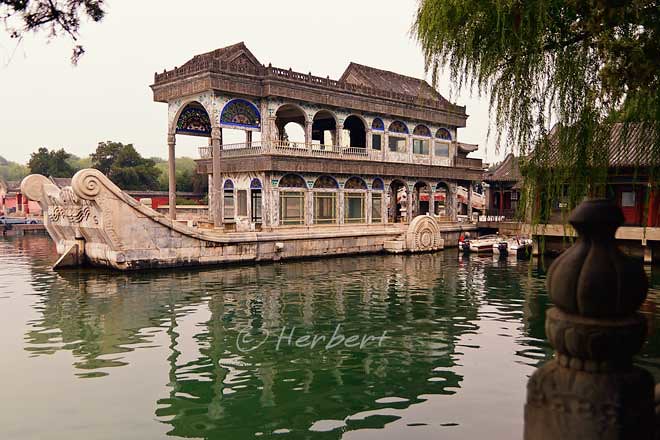
Location: Marble Boat, YiheYuan, Beijing, China(39� 59' 48.4? N, 116� 15' 48.9? E)
Date: 19 October 2010, 11.10am
Camera: Canon 500D with Sigma 17-70/f2.8-4.5

Yuheyan, the Summer Palace was the summer retreat of the Chinese Emperors/Empress. The Palace is actually a landscape garden with a variety of pavilions, gardens, palaces etc centred around Kunming Lake and Longevity Island. The man-made lake was an imitation of Xihu of Hangzhou and the soil excavated from the lake was used to make Longevity Hill. The Summer Palace was destroyed twice �during the Anglo-French allied invasion of the 1860 2nd Opium War and during the attack by the eight allied powers in the 1900 Boxer Rebellion. The Old Summer Palace (YuanMingYuan) was also destroyed in the 2nd Opium War and was burnt down with looting and plundering of Chinese arts and treasures by British and French soldiers. Whilst the YiheYuan was rebuilt after the 1st destruction, YuanMinYuan was left as it is. Ironically the rebuilding of YiHeYuan by diverting funds originally designated for the Chinese Navy contributed to her second destruction. The destructions of these compounds etched a deep wound in the Chinese psyche as they represent the apex of Chinese humiliation and bullying in the hands of Western powers. These events continue to shape the mind and thinking behind some of China�s foreign and defence policies today.

One of the iconic structure in YiHeYuan is the so-called Marble Boat, a lakeside pavilion on the grounds of the Palace. It is a 2 storey structure which is not actually marble. It has a large stone base with wooden superstructure painted to imitate marble.

Read more »

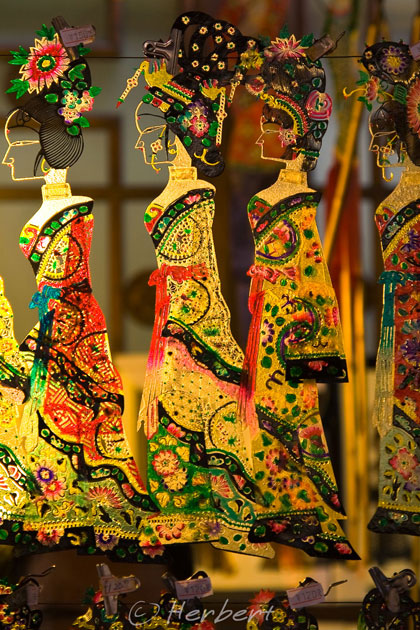
Location: Wuhouci, Chengdu, China (30� 39' 35? N, 104� 3' 48? E)
Date: 10 October 2008; 2.50pm
Camera: Canon 400D with Canon 70-200 f/4 L IS Lens

One of my favourite activities while travelling in China used to be shopping for handicrafts and collectibles. I enjoyed collecting unique handicrafts- those only produced in very small quantities and perhaps one-of-its-kind and not-too-perfect pieces rather than the factory mass-produced pieces. In the early days when China started opening its doors to outsiders, one can pick up many valuable collectibles at very good prices. For instance, I remembered buying a fabulous wood carvings from bed rests during my first trip in 1996 that used to have a vaunted place on my display shelf. However these days, anything closely resembles uniqueness are very expensive in China. That�s why I do not spend time looking for them anymore- only occasionally browsing just to see what�s in the market. Furthermore I do not have a big enough place to even showcase my current collection- adding more is just going to go to the storage.

Read more »

Location : Tingri region, Tibet, China (28� 34' 0? N, 86� 38' 0? E)
Date : 28 April 2003; 8.25am
Camera : Canon G1
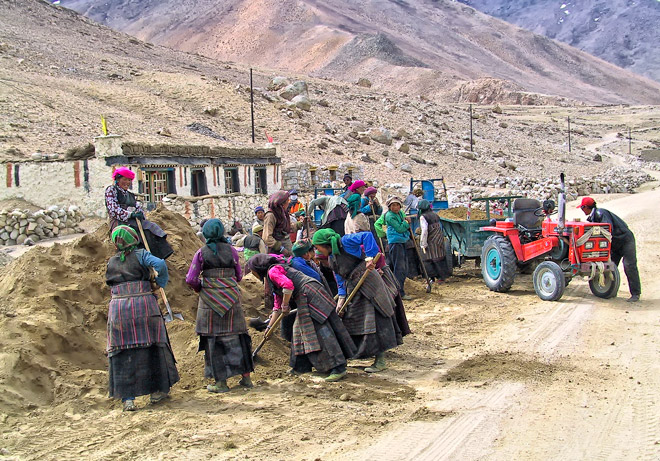
Tibet is developing so fast that it is quite mind boggling. Billions are poured into the province�s transport infrastructure with the headlining rail connection to Lhasa. Apart from that, China is building the world�s highest airport at Ngari (base to explore Mount Kailash), airport in and extension of the Lhasa rail line to Shiigatse. It is also expanding and improving the road network in the province. Few years ago the road between Lhasa and Shiigatse was a single lane bitumen road; now it is a 4-lane highway! However most of the roads in Tibet are under-utilized. It is not unusual to be on one of these roads for 20 or so minutes before encountering another vehicle. Most of the constructions connecting the major centers are undertaken with heavy machineries but some of the lesser connections are invariably still mainly built by manual labour, with little heavy machinery. This photo was the norm as far as road construction is concerned about 8 years ago- men and womenfolks using shovels- and is still the same in the smaller town connections.

Read more »

Location: Tian Tan, Beijing, China(39� 52' 56.07? N, 116� 24' 23.29? E)
Date: 18 October 2010, 9.10am
Camera: Canon 500D with Sigma 17-70/f2.8-4.5

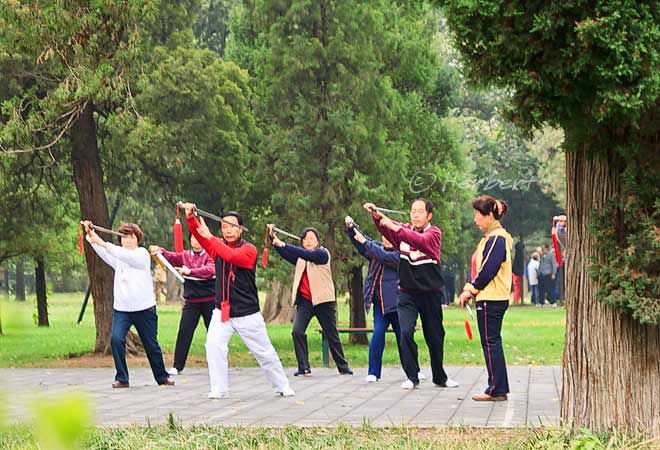
I am always amazed by how healthy the elderlies of China are. Whether in the rural farming areas or in the cities, the majority of the elder folks in China are generally very healthy and mobile. I supposed the cause of this in the rural areas is the laborious nature of their life in the farms while in the cities, the reason is their devotion to exercises of all sorts. In fact in the cities, one can always see the residents exercising in the parks in the mornings and evenings. A popular exercise is of course, taiji; but it is by no means limited to that. Some of the more popular exercises/sports are dancing, badminton and the various forms of light martial arts.

Read more »

Locations: Zhencong, Guizhou, China( 25�54'30.67"N 109�11'43.82"E)
Date: 17 April 2005; 8.15am
Camera: Canon 300D with kit lens

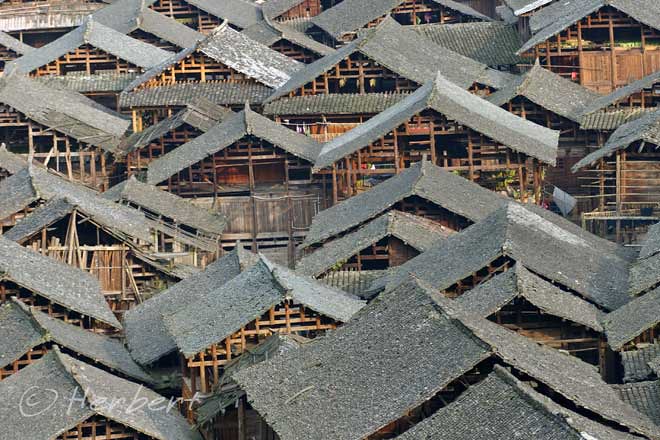
Guizhou is a treasure trove for travelers who enjoy experiencing ethnic diversity. Even though the province does not have as many different ethnic groups as Yunnan, it is less developed due the landscape- hilly and not-as-good transport links. Therefore the ethnic minorities in this province are more �genuine� in their practices and lifestyle; whereas in many parts of Yunnan, many of the ethnic practices are staged for tourists. The ethnic minority in this province is dominated by three large groups- the Zhuang, Dong and Miao. The Dong are most well-known for their Drum Towers and majestic Wind and Rain Bridges while the Miaos are known for their festivals, diversity and their signature stilt dwellings. Many of these villages are now popular tourist destinations though there are still some gems that are well-hidden- too difficult and convoluted to visit. One example is the Dong village of Zhengcong which is a small village surrounded like an island by a stream with beautiful surroundings and houses. The villagers still practice their own custom and go around their business in their traditional costumes. It is one of those places where you will not find a guesthouse or anything close to it.

Read more »

Location: Siguniang Shan, Sichuan, China (30�59'59.57"N 102�51'4.85"E)
Date: 29 October 2006, 4.40pm
Camera: Canon 300D with kit lens

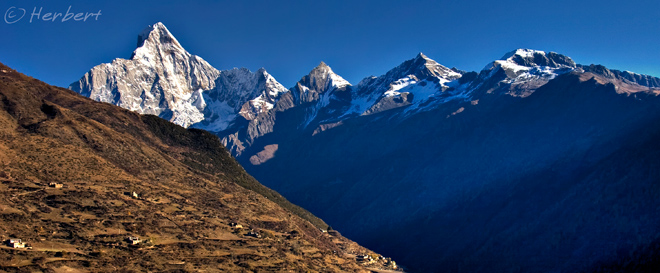
Siguniang Shan means the �4 Sisters Mountains�. It is located in the Aba Tibetan Autonomous Prefecture in Sichuan, the same prefecture of the famed Jiuzhaighou Scenic Reserve. Siguniang is a Nature Reserve as well and is managed by the same company that has managed Jiuzhaighou. Hence the protocol of visiting this place is similar to Jiuzhaighou- one pays for entrance fee and a fee for the hop-on-hop-off bus service within the Reserve. There are three valleys within the reserve and there is an entrance fee (separately) for each valley.

Siguniang is well-known for its snow peaks, valleys, forests, lakes and biology. It is a UNESCO Heritage Site together with the Wolong and Jiajin Mountains forming the Sichuan Giant Panda Sanctuaries. According to the legend of the local Tibetan people, millennia ago there was a mountain god named Balang who had four beautiful daughters. The youngest of them was the tallest and had the most graceful figure. A devil admired the girls and wanted to marry them. So the devil challenged Balang to a fight for the girls. The devil won the battle and killed Balang, so the girls fled but eventually died from cold weather. Their bodies became the Siguniang Mountains and their father became the Balang Mountain. The Siguniang Mountains stand graceful, shoulder by shoulder plunging their heads into the clouds, with glaciers wrapping around their shoulders and green forests around their waists. The youngest girl is the tallest at 6,250m above sea level.

Read more »

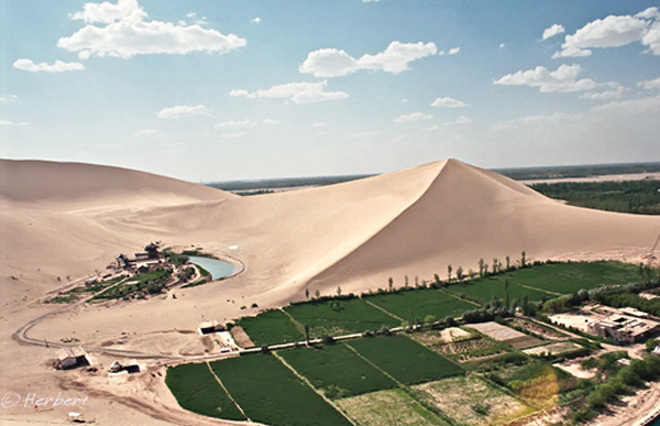
Locations: Mingsha, Gansu, China (40�5'18"N 94�40'33"E )
Date: 5 October 2008; 9.20pm
Camera: (analogue) Canon 500N with negatives and scanned

Dunhuang is one of the most interesting stops along the Silk Route of China. On top of its strong Hui (Muslim Chinese) traditions, it has history, thanks in no small part to the infamous tomb-raiding feats of a Aurel Stein, who nearly cut out all the murals of the Mogao Caves and shipped them back to Britain. Dunhuang also has the magnificent Mingsha Desert (Mingsha is so named for the sound of the singing sand, being wind whipping off the dunes). The sand dunes are situated at the edge of town and are fringed by green farmlands as seen above. Most visitors to Mingsha would probably not realised this as one has to climb up one of the higher sand dunes to have a panoramic view to appreciate the amazing nature of the landscape.

Technorati Tags: ,,
Read more »

Location: Namtso, Tibet, China, (30� 42' 0? N, 90� 33' 0? E)
Date: 21 April 2003; 7.05am
Camera: Canon G1

Namtso meaning Heavenly Lake in Tibetan, is one of 3 holy lakes of Tibet; the other 2 are Manasarovar and Yamdroktso. Namtso is also the biggest lake in Tibet, the highest lake (4,718m) in the world and the 2nd largest saltwater lake in China (after Qinghai Lake) . Tibetans Buddhists believe Buddha will assemble to hold religious meeting at Namtso in the year of sheep on the Tibetan calendar. So circumambulation (kora) around the lake at the right moment equals 100 thousand times of that in normal years. Every year thousands of Buddhists from Tibetan areas in the 5th & 6th month of the Tibetan calendar, come to the lakeside on pilgrimage to pay homage and pray.

This and many other beautiful places in Tibet are now less accessible to foreigners like me. After the pro-Tibet protests prior to the 2008 Olympics, China had clamped down and strictly enforced the travel restrictions on foreigners to Tibet. These days no independent travellers can get to Tibet without going through the necessary paperwork. To travel there, one not only require a Tibet Travel Permit (TTB) as in the past, a full package have to be booked beforehand with guide and a vehicle ready (if one wants to travel outside Lhasa) when one lands in Lhasa. In other worlds, unlike in the past when one can do travel arrangements including vehicle while in Lhasa, all of these must be done before getting to Tibet. Furthermore there are more checkpoints where TTB are actually checked. I considered myself lucky to have already visited so many places and met so many people in Tibet- many of which were already off-limit to foreigners in the past.

Technorati Tags: ,,
Read more »

About

Nothing happens when you sit at home. I always make it a point to carry a camera with me at all times…I just shoot at what interests me at that moment. – Elliott Erwitt"
“I treat the photograph as a work of great complexity in which you can find drama. Add to that a careful composition of landscapes, live photography, the right music and interviews with people, and it becomes a style.” – Ken Burns